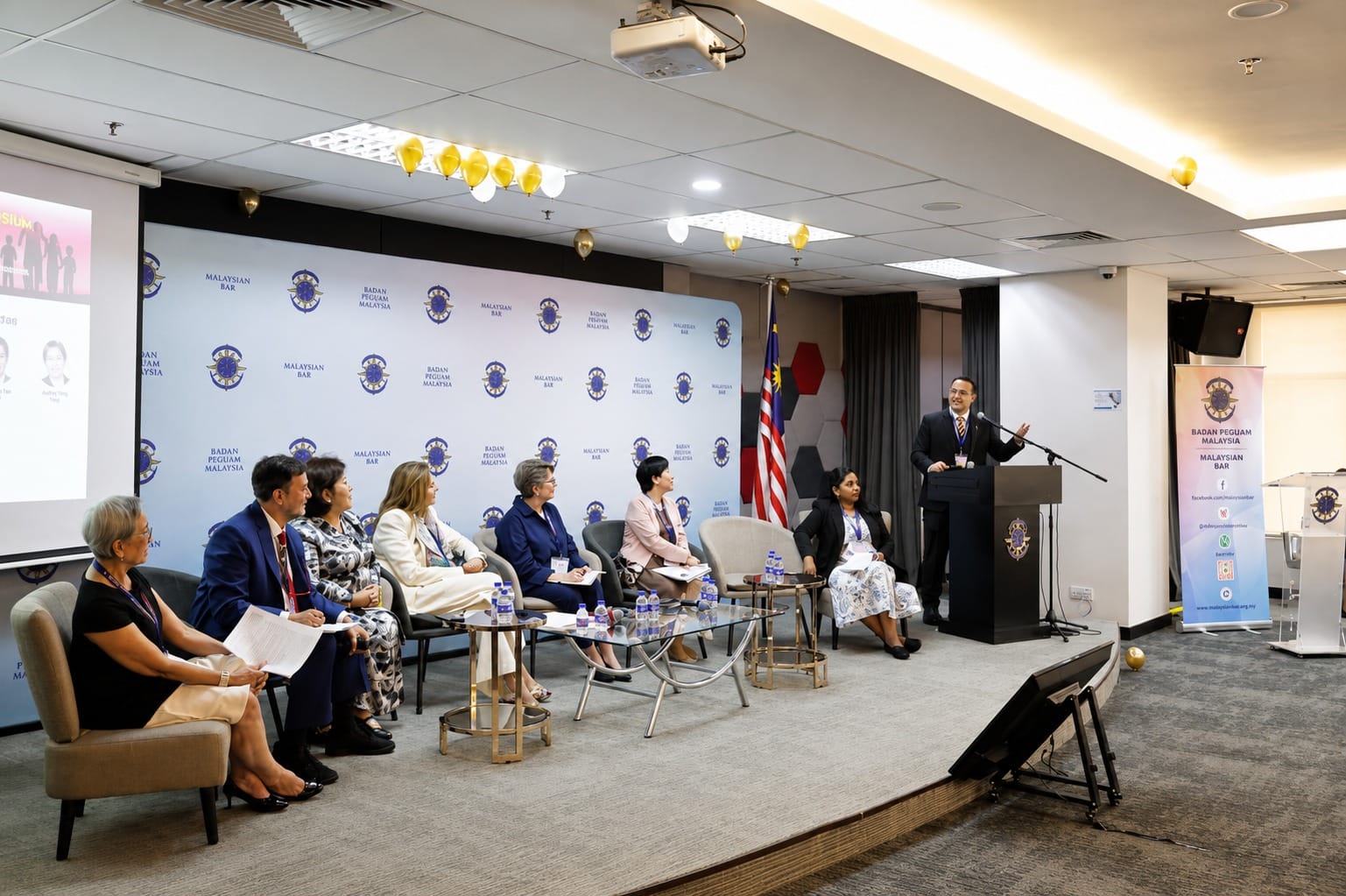
Dr. Hassan Elhais stands out as one of the best family lawyers in Dubai and Abu Dhabi for handling complex cases involving children, particularly those that demand rigorous cross-border enforcement of custody. As the elected co-chair of the Relocation of Children Committee of the International Academy of Family Lawyers (IAFL), he recently spoke on key legal issues impacting expatriate families at the IAFL Asia Pacific Symposium in Kuala Lumpur. With deep expertise tailored to expats living in the UAE, Dr. Elhais frequently manages cross-border matters such as parental child abduction and the enforcement of foreign financial judgments. During his address, he extensively discussed the ongoing challenges of international custody disputes alongside proposed legal system improvements designed to help families navigate multiple legal systems concurrently.
Navigate UAE law with confidence. Become a part of r/KnowTheLaw —your Reddit group for sharp analysis, strategic advice, and real solutions to complex legal matters.

Dr. Hassan Elhais Presents at IAFL Asia Pacific Symposium in Kuala Lumpur
The IAFL Asia Pacific Symposium took place in Kuala Lumpur, Malaysia, on May 19, 2026, hosted by the Malaysian Bar Council. This specialized event was held just ahead of the larger IAFL Asia Pacific Chapter Meeting, scheduled for May 20–24, 2026, at the Grand Hyatt Kuala Lumpur.
The Significance of IAFL’s Regional Symposiums
The International Academy of Family Lawyers (IAFL) is a prestigious worldwide association composed of practicing lawyers, academics, and members of the judiciary who are recognized by their peers as the most experienced and skilled family law specialists in their respective countries. Established nearly 40 years ago, the IAFL now boasts more than 930 fellows spanning 67 jurisdictions. The organization’s core mission centers on improving the global practice of law and the administration of justice surrounding divorce and family matters. Its regional symposiums intentionally feature international experts and premier family lawyers to tackle emerging developments and challenges in cross-border family law, offering practitioners an invaluable platform to exchange strategies with global counterparts.
Dr. Hassan Elhais’s Role as Co-Chair of Relocation of Children Committee
Dr. Elhais brings over 18 years of experience as a legal consultant at Amal Alrashedi Lawyers & Legal Consultants, a highly reputable family law firm operating in the UAE. Over his career, he has built expansive expertise across arbitration, family law, inheritance law, and the meticulous drafting of legal documents. His strong educational foundation includes a diploma in private law (covering Shariah law, philosophy of laws, litigation law, commercial law, and civil law), a Master’s degree in Law, and a PhD in Law awarded in 2019. His election as the co-chair of the IAFL Relocation of Children Committee directly reflects his deep specialization in disputes involving children, specifically those containing complex international elements like relocation conflicts and multi-jurisdictional custody arrangements.
Key Topics Addressed During the Presentation
The symposium maintained a sharp focus on cross-jurisdictional family disputes, with Dr. Elhais presenting directly on the cross-border enforcement of custody in multi-jurisdictional cases. His presentation broke down the distinct manners in which global legal systems approach the recognition and enforcement of foreign custody orders—a topic of paramount concern for expatriates residing in the UAE who maintain strong legal and personal ties to multiple nations.
How Cross-Border Custody Enforcement Works in Multi-Jurisdictional Cases
A central reality of international family law is that foreign custody orders are not automatically enforceable when moving across jurisdictions. Instead, achieving recognition is dictated entirely by local domestic law, comity, reciprocity, and the principles of res judicata. For instance, the United States lacks any bilateral treaties or multilateral conventions with other nations concerning the reciprocal recognition and enforcement of family judgments. Consequently, whether a foreign court chooses to enforce a judgment from another country remains a localized question of internal statutory law and international comity.
Generally, foreign states reserve the right to audit external judgments based on four primary components:
- Verifying whether the issuing court possessed proper jurisdiction.
- Confirming the defendant received proper and legal notification.
- Establishing that fraud did not corrupt or vitiate the legal proceedings.
- Ensuring the judgment does not violate or contradict the public policy of the destination country.
Judgments that involve multiple or punitive damages face steep, distinct hurdles when attempting to secure enforcement abroad.
Enforcement Mechanisms Under International Treaties
For nations that are signatories, the Hague Convention on the Civil Aspects of International Child Abduction sets out a uniform civil remedy. Each member state designates a specific Central Authority to serve as the primary operational link for parents and foreign governments. Applications and supporting documents routed through these Central Authorities are directly admissible in courts, bypassing the traditional, lengthy legal formalities normally required for foreign documentation.
Challenges Facing Expatriate Families
Custody conflicts represent a uniquely stressful and distinct obstacle for expatriate circles. Because the UAE is not a contracting state to the Hague Convention, there is no automatic treaty-backed return mechanism in place. This makes preventative legal action incredibly vital; practitioners must act decisively before a child is removed from a country, rather than trying to resolve the dispute after an overseas relocation has already established a new status quo.
The Role of Hague Convention in Custody Disputes
The Hague Convention applies strictly to children under the age of 16, stipulating that custody arguments must be handled by the courts located in the child’s country of habitual residence. To succeed in a return claim, parents must prove the child habitually lived in a Convention country, that the removal to another Convention country was legally wrongful, and that they were actively exercising their custodial rights at the time. Conversely, a court can legally refuse a return order if a clear, serious risk exists that the child would be exposed to physical or psychological harm upon return.
What Professional Lawyer Dr. Hassan Elhais Shared About UAE’s Approach to International Custody
Dr. Elhais used his presentation to outline the UAE’s distinct, rapidly evolving legal framework for managing international custody matters. Federal Decree-Law No. 41 of 2022 fundamentally shifted the landscape by introducing the core principle of joint custody and extending the baseline age of custody to 18 years. Following this, Cabinet Resolution No. 122 of 2023 tightened the administrative rules regarding traveling abroad with children without explicit parental consent. These structural reforms are further strengthened by the UAE’s formal designation of 2026 as the “Year of the Family”, an initiative driving enhanced procedural guidance alongside dedicated family court resources.
UAE Courts’ Framework for Cross-Border Cases
Parents seeking to enforce a UAE-issued custody order abroad must formally petition the courts of that specific foreign country to recognize and enforce the judgment. The likelihood of success heavily relies on whether the destination country shares a bilateral judicial cooperation agreement with the UAE, and whether the order aligns with local public policy standards.
Mirroring this process, to enforce a foreign custody order within the UAE, an application for formal recognition must be filed directly with the UAE courts. During review, the UAE court evaluates three primary items:
- Whether the foreign order was handed down by a competent jurisdiction.
- Whether both parties were granted a fair opportunity to be heard.
- Whether the order remains fully compatible with the public policy and order of the UAE.
Reconciling Shariah Law with International Standards
The UAE judiciary examines all foreign custody orders to ensure absolute compliance with UAE public order, domestic laws, and foundational Shariah principles. Based on this scrutiny, courts may opt to uphold a portion of a foreign ruling while rejecting another, or they may order entirely new local proceedings before granting any measure of recognition. This intense level of case-by-case review inherently creates less predictable outcomes for expat families navigating disputes.
Common Obstacles in Enforcing Foreign Judgments
The most immediate and readily enforceable legal instrument available inside the UAE is a travel ban. If a parent holds a well-founded suspicion that the other parent is organizing an unauthorized departure from the country with a child, they can file an emergency application for a travel ban through the police or the courts.
“The UAE is not a signatory to the Hague Convention which makes enforcement difficult as there is no streamlined mechanism for return between the UAE and signatory states,” highlighted Dr. Hassan Elhais.
Why Global Legal Collaboration Matters for Family Law Practitioners
Emerging Trends in International Child Custody
The market demand for seasoned international family law experts continues to climb sharply; in fact, 75% of family law solicitors in England and Wales reported a notable rise in international family law cases as early as 2020. Cross-border disputes—specifically those focused on parental responsibility and international parental child abduction—are increasingly being routed toward and resolved through structured mediation.
Practical Takeaways for Legal Professionals
To keep pace, specialized training programs are emerging globally to support practitioners. For example, the IAFL’s European Chapter designed a comprehensive four-week online training course covering introductory aspects of European cross-border family law for junior lawyers, focusing heavily on divorce, children, maintenance, and matrimonial property.
Conclusion
Through his presentation at the IAFL Asia Pacific Symposium, Dr. Hassan Elhais shed light on the mounting complexities facing expatriate families in cross-border custody standoffs. His operational knowledge of multi-jurisdictional legal systems, paired with a deep understanding of the UAE’s unique custody frameworks, remains vital for families with international connections. As global mobility increases, the legal field requires highly specialized family lawyers who are thoroughly well-versed in international treaties and localized enforcement protocols to effectively protect the best interests of children across borders.
Key Takeaways
- Proactive Prevention: Because the UAE is not a member of the Hague Convention, automatic return mechanisms do not exist; preventing unauthorized relocation via early legal steps is far more effective than trying to enforce an order post-relocation.
- Strict Local Scrutiny: International custody orders cannot be automatically deployed; they must first win formal recognition from local courts and align with the public policy criteria of the destination country.
- Immediate Protection Tools: Travel bans represent the swiftest enforcement tool inside the UAE, enabling parents to halt unauthorized travel by filing emergency court applications.
- Rising Global Case Volumes: Professional networking platforms, like the IAFL symposiums, are essential as 75% of family lawyers report an upward trend in international cases.
- Impactful UAE Law Reforms: The 2022 UAE law updates directly alter expat family planning by installing clear joint custody rules and raising the custody age threshold to 18 years.