So what’s actually changing on the ground? Here’s a clear breakdown of how the war is affecting life in the UAE in 2026, based on current trends and observed impacts.
8 Ways the Regional Conflict is Affecting the UAE (2026)
1. Travel and Flight Patterns Are Changing
Air travel has been one of the most visibly affected areas. Airlines operating through major global hubs like Dubai International Airport (DXB) have had to dynamically adjust certain flight paths due to regional airspace considerations.
While international flights continue to operate daily, passengers traveling to, from, or through the region may experience:
- Longer overall travel times due to rerouting
- Strategic route diversions around sensitive zones
- Occasional scheduling delays
For most residents and corporate travelers, flight routes remain accessible, but advanced planning and flexible schedules have become significantly more important.
2. Tourism Demand Is Becoming More Cautious
Dubai and the wider UAE continue to welcome international tourists, but short-term travel sentiment has visibly shifted. Some travelers are adopting a more conservative approach by postponing regional trips, shortening their planned stays, or opting exclusively for flexible, refundable bookings.
Conversely, domestic tourism and staycations are seeing a notable surge in demand, as residents choose to spend their leisure time and capital closer to home in nearby emirates.
3. Consumer Spending Is Becoming More Selective
During periods of geopolitical uncertainty, household economic behavior shifts toward safety. Across the UAE, this has translated into a noticeable rise in cautious retail spending and a sharp reduction in non-essential impulse purchases.
While luxury spending certainly still exists, overall consumer behavior is becoming far more calculated, with a renewed domestic focus on savings and financial liquidity.
4. The Real Estate Market Is Slowing—but Not Stopping
Dubai’s real estate sector remains highly active, but the frantic pace of previous years has adjusted to a more measured cadence. Current property trends include slower overall transaction cycles and an increase in price negotiations between buyers and sellers.
Furthermore, there is a distinct increase in buyer interest toward ready, completed properties over speculative off-plan investments. Investors are still actively entering the market, but their capital placement is guided by long-term wealth preservation rather than short-term speculative gains.
5. Businesses Are Entering a More Defensive Mode
Many companies in the UAE are adapting to the current environment by becoming more cautious. Common operational adjustments include delaying ambitious expansion plans, aggressively controlling overhead costs, and doubling down on core, proven revenue streams.
Industries tied tightly to regional logistics, hospitality, and brick-and-mortar retail are demonstrating the highest sensitivity to these ongoing developments.
6. Gold and Safe-Haven Assets Are Gaining Demand
Periods of heightened geopolitical tension traditionally push global and local investors toward historically secure assets. In Dubai, retail and institutional demand for gold has increased significantly as individuals look to insulate their wealth from broader market volatility. This trend closely mirrors global market patterns where capital prioritizes stability over risk.
7. Logistics and Supply Chains Are Under Pressure
As a vital linchpin in global maritime and air trade, the UAE is inevitably exposed to regional transit disruptions. Current logistics strains have materialized as longer shipping times, increased freight insurance and logistics costs, and the occasional rerouting of sea cargo.
However, Dubai’s world-class port infrastructure and highly diversified supply lines continue to support strong, continuous trade flows despite these logistical headwinds.
8. Daily Life Remains Largely Stable
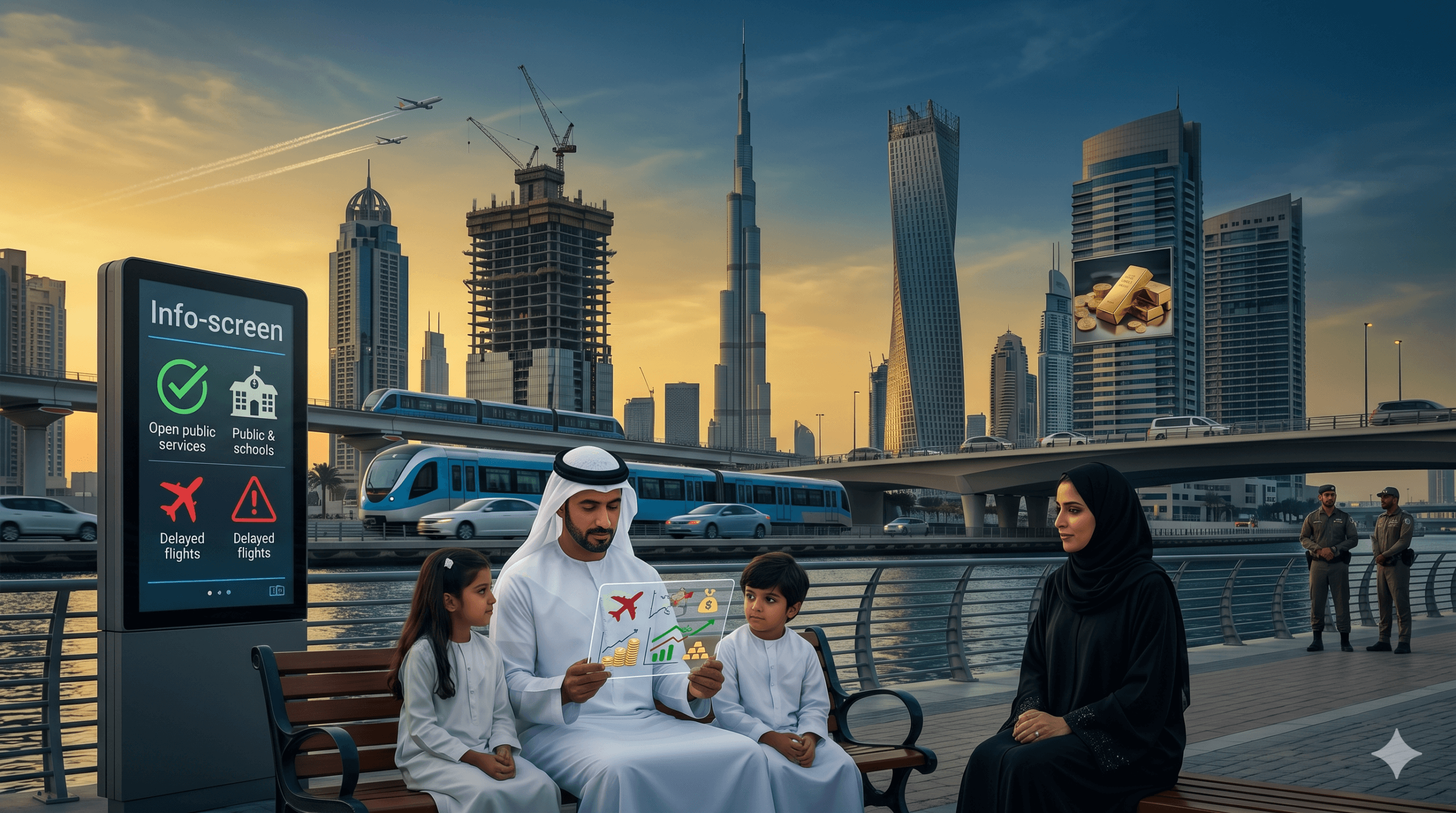
Despite these macroeconomic and behavioral shifts, it is crucial to emphasize that day-to-day life inside the UAE remains completely normal for the vast majority of residents. Public infrastructure continues to function seamlessly:
- Schools, universities, and nurseries remain open and fully operational
- Private and public businesses are operating on normal schedules
- Public services, safety networks, and government utilities continue without interruption
The UAE government’s ability to maintain a secure, highly predictable internal environment explains why the country continues to successfully retain and attract global expatriates and foreign direct investment.
Key Takeaway
The current conflict is undoubtedly influencing consumer psychology, corporate strategy, and investment speeds—but it has not fundamentally disrupted daily life inside the borders of the UAE. Instead, the impact is structural and subtle, characterized by increased caution, slower corporate decision-making cycles, and a collective shift toward economic stability.
Frequently Asked Questions
Is the UAE safe during the current conflict?
Yes. The UAE remains exceptionally safe and internally stable. Daily civil operations, tourism, and business activities proceed as normal across all seven emirates.
Are flights affected in Dubai?
Flights are operating continuously out of Dubai’s major airports. However, because certain air corridors are avoided due to regional airspace considerations, some flight paths have been altered, occasionally resulting in longer flight durations.
Is Dubai’s economy slowing down?
Economic growth remains positive, but specific sectors—particularly hospitality, luxury retail, and high-volume real estate trading—are experiencing a more cautious, measured pace compared to the boom periods of recent years.
Should investors be worried?
While heightened awareness is recommended, there is no widespread capital flight. Most institutional and private investors are adjusting their timelines and risk profiles—focusing on defensive assets and ready real estate—rather than exiting the UAE market entirely.