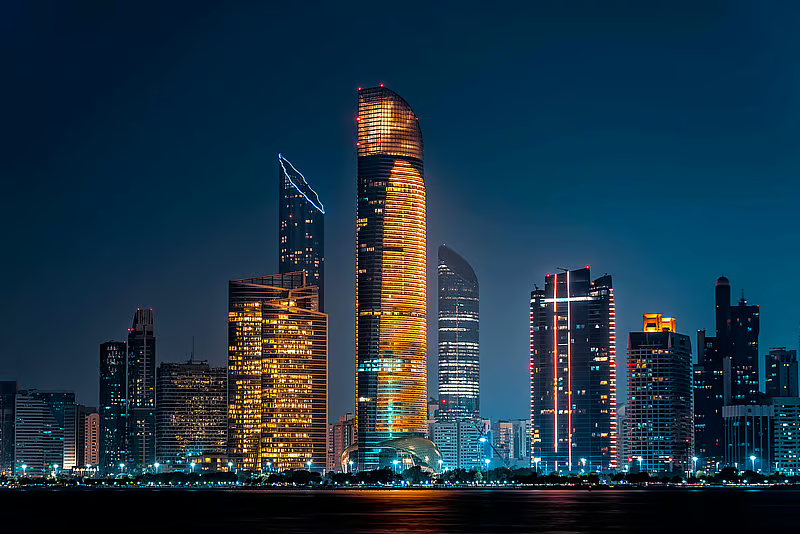
The UAE real estate market in March 2026 is no longer just a story about rising prices, luxury demand, and population growth. It is now also a story about war risk.
The ongoing U.S.-Israeli conflict with Iran has introduced a new layer of uncertainty into the UAE economy and property market. Iranian attacks across the region, threats tied to the Strait of Hormuz, and security incidents affecting Dubai have all started to test investor confidence. Reuters reported that even Dubai’s reputation as a regional safe haven has come under pressure, with some investors reassessing whether to keep capital concentrated in the emirate.
War Is Now Affecting Sentiment in Dubai and Abu Dhabi
The immediate impact has been strongest on sentiment, not yet on a full collapse in transactions.
Reuters reported that UAE equities fell sharply as the conflict deepened, with Dubai’s main index down 1.7% on March 13 and Abu Dhabi’s index down 1.6%. Real estate stocks were directly hit, including Emaar Properties and Aldar, showing that investors are actively repricing regional risk. Reuters also noted minor damage near Dubai International Financial Centre from intercepted debris, underlining that the conflict is no longer perceived as distant.
That matters for real estate because UAE property — especially in Dubai — depends heavily on international capital, high-net-worth buyers, and confidence in the country as a stable place to park wealth. Reuters said the property sector is facing a “reckoning” because that safe-haven image has been shaken by the Iran strikes.
The Market Has Not Frozen, but Buyers Are More Cautious
Despite the war, the market has not stopped.
The National reported that Dubai still recorded 3,570 sales transactions worth Dh11.93 billion between March 2 and 9, and activity continued in both the secondary and off-plan segments. Khaleej Times also reported that UAE developers and brokers were still seeing major deals close, including transactions above the $100 million level, even as some buyers paused decisions.
So the March reality is more nuanced: the war has not crashed the UAE property market, but it has clearly made buyers, investors, and institutions more selective.
Luxury Real Estate Is More Exposed Than Before
The biggest risk is not only broad market slowdown — it is capital flight at the top end.
Reuters reported that some wealthy Asian investors, who had previously treated Dubai as a wealth haven, were considering moving assets closer to home or postponing further purchases because of war fears. That is important because the luxury and ultra-luxury segments in Dubai and Abu Dhabi rely heavily on offshore demand.
At the same time, Abu Dhabi’s property market has still shown resilience. Khaleej Times reported more than $1 billion in weekly real estate deals in March, suggesting that domestic strength, sovereign depth, and premium demand have not disappeared.
Events, Travel, and Logistics Risks Also Matter for Property
The war is affecting more than investor psychology.
Reuters reported that the Dubai crypto event TOKEN2049 was postponed because of safety concerns, travel disruption, and logistical uncertainty tied to the regional conflict. Reuters also reported heightened fears around oil and shipping disruption, especially involving the Strait of Hormuz. Those issues matter to real estate because the UAE property market is closely linked to tourism, aviation, trade flows, and executive mobility.
If conflict risk remains elevated through March and April, the likely outcomes are:
- slower decision-making from foreign buyers
- pressure on speculative off-plan demand
- stronger preference for prime, defensive, or ready properties
- more attention on Abu Dhabi’s relative stability and institutional backing
What March 2026 Really Means for UAE Real Estate
The March story is this: the market is resilient, but no longer untouchable.
Dubai and Abu Dhabi are still seeing transactions, and the structural drivers — wealth migration, population growth, and long-term demand — have not vanished. But the war has introduced a real risk premium into the UAE property conversation. The market is no longer moving on optimism alone; it is now being tested by geopolitics, investor nerves, and questions about whether the UAE can fully preserve its safe-haven status if the conflict worsens.
FAQ
Is the war affecting UAE real estate in March 2026?
Yes. The war is affecting investor sentiment, regional risk pricing, and confidence in Dubai’s safe-haven positioning, even though transactions are still happening.
Has the Dubai property market crashed because of the war?
No. Activity is still continuing, but buyers are more cautious and some foreign investors are reassessing exposure.
Which part of the market is most vulnerable?
Luxury and internationally funded segments are the most exposed because they depend heavily on offshore capital and confidence.
Is Abu Dhabi more resilient than Dubai right now?
Abu Dhabi appears relatively resilient, with strong weekly deal activity and deeper institutional support, though it is not immune to regional risk.